Director of Marketing & Growth
Every electronics program reaches the same sourcing decision. Should your contract manufacturer buy the components, or should you? The choice between consigned vs turnkey PCB assembly shapes who controls the parts, who carries lead time and shortage risk, and how traceability gets documented. For medical device and defense programs, where part integrity and records are audited, that choice deserves more attention than a line on a quote.
This guide explains how each model works, where the risk sits, and the questions regulated OEMs should ask before deciding.
What Is Consigned PCB Assembly?
In consigned PCB assembly, the OEM supplies all or most of the components. The contract manufacturer provides the assembly expertise, equipment, inspection, and testing. The OEM keeps control of sourcing, supplier relationships, pricing agreements, and inventory.
Companies usually choose consignment when the parts themselves carry strategic value. That includes proprietary or IP-sensitive components, ITAR-controlled material, obsolete parts from a last-time buy, and existing stock the company has already paid for. Consignment lets that inventory go straight into production without being repurchased.
What Is Turnkey PCB Assembly?
In turnkey PCB assembly, the contract manufacturer takes responsibility for the full build. It sources components, manages inventory and lead times, handles obsolescence and alternative sourcing, assembles and tests the product, and coordinates delivery. The OEM works with one accountable partner instead of coordinating multiple vendors.
Turnkey suits programs that want to reduce administrative overhead and free their team to focus on product development. It also puts counterfeit prevention in the manufacturer’s hands, since parts come through the manufacturer’s own sourcing channels.
Partial Consignment and Hybrid Sourcing
The two models are not all or nothing. In a hybrid approach, sometimes called partial turnkey, the OEM supplies a few critical, controlled, or customer-specified parts while the manufacturer sources the rest. This keeps tight control where it matters most without taking on the purchasing work for every resistor and capacitor. If a split appeals to you, ask your contract manufacturer how it handles shortages and traceability when parts arrive from two sources.
Where the Risk Sits in Each Model
Neither model removes risk. Each one moves it to a different place. The table below shows who carries what.
| Consigned | Turnkey | |
|---|---|---|
| Component sourcing | The OEM buys the parts and manages suppliers | The contract manufacturer buys the parts and manages suppliers |
| Counterfeit exposure | Depends on where the OEM bought the parts, so incoming inspection carries more weight | Controlled through the manufacturer’s sourcing, typically from authorized distributors |
| Shortages and attrition | A short kit can delay the build until the OEM resupplies | The manufacturer resolves shortages within its own supply chain |
| Lead time | The OEM carries sourcing lead time; the manufacturer adds time to validate parts and prepare kits | The manufacturer carries sourcing lead time |
| Traceability | Begins with the OEM’s purchasing records and continues at the manufacturer’s receiving dock | Recorded by the manufacturer from purchase order through final build |
| Administrative load | The OEM manages purchase orders, suppliers, and kit preparation | The manufacturer manages procurement and inventory |
What Regulated Programs Need to Weigh
Traceability and Documentation
Medical device and defense programs need a documented chain from each component’s source to the finished assembly. Quality management systems such as ISO 13485 require documented control over purchased materials. In a turnkey build, the manufacturer records that chain from its own purchase orders. In a consigned build, the chain starts with your purchasing records and continues at the manufacturer’s receiving dock. At VR Industries, lot and date codes are verified at receiving and carried into the work order, so the record stays connected from receiving to final assembly.
Counterfeit Exposure
Defense contractors working under DFARS 252.246-7007 must maintain a counterfeit electronic part detection and avoidance system, and that requirement flows down to suppliers of electronic assemblies. In a turnkey model, sourcing from authorized distributors is the first line of defense. In a consigned model, part provenance depends on where the OEM bought the parts, so the manufacturer’s incoming inspection matters more. VR Industries verifies consigned components through visual examination, electrical testing, and high-resolution X-ray inspection, and that X-ray analysis has identified counterfeit components in customer-supplied material before they reached production.
ITAR-Controlled Material
Programs that handle ITAR-controlled components often prefer consignment because it keeps controlled material inside their own procurement chain. Whichever model you choose, the manufacturer should be ITAR registered and should run material and document control systems built for defense work. VR Industries is ITAR registered and supports ITAR and military circuit card assembly programs.
Obsolescence and Long Program Lifecycles
Long-lifecycle programs often hold last-time-buy inventory for parts that are no longer made. Consignment puts that stock to work. Turnkey hands obsolescence monitoring and alternative sourcing to the manufacturer’s supply chain management team, which can reduce the burden on smaller engineering groups.
Choosing Consigned vs Turnkey PCB Assembly
Consignment is often the better fit when your program has the following.
- Proprietary, IP-sensitive, or ITAR-controlled components you want to keep in your own supply chain
- Existing inventory, last-time buys, or pricing agreements you want to use
- A purchasing team with the capacity to manage suppliers and prepare complete kits
Turnkey is often the better fit when your program has the following.
- A lean team that wants one partner accountable for sourcing and production
- A bill of materials with many commodity parts and ongoing lead time exposure
- A need for the manufacturer to manage obsolescence and alternative sourcing
Switching Models as a Program Matures
The sourcing decision is not permanent. Many programs change models as they move through the product lifecycle, and planning for that shift early avoids disruption later.
During prototyping and new product introduction, engineering teams often consign parts. They may already have components on hand from development, need a small number of boards quickly, or want to test specific part numbers before locking the bill of materials. VR Industries supports low-volume New Product Introduction builds with consigned materials, so teams can validate designs and processes before committing to production quantities.
As designs stabilize and volumes grow, managing purchase orders and kits for every build becomes a real workload for the OEM. Moving to turnkey at that point hands procurement, inventory, and lead time management to the manufacturer, which can then apply bill of materials optimization and safety stock programs across ongoing builds.
The shift can also run the other way. When a long-running program faces component obsolescence, an OEM may make a last-time buy and consign that stock so production can continue. In either direction, the transition goes smoothest when the manufacturer already holds your documentation, revision history, and quality records. Staying with one partner across both models keeps your traceability and build history in one place.
Common Kit Mistakes That Delay Consigned Builds
In a consigned build, most delays trace back to the kit rather than the assembly line. These are the issues that most often hold up production.
- Kits that do not match the current revision. If the bill of materials changed after parts were ordered, the kit can arrive with obsolete or missing line items, and the build waits while the discrepancy is resolved.
- Too few extra parts. Automated placement loses a small number of parts during machine setup and handling, especially small passives. A kit with exact quantities can come up short partway through a build.
- Packaging the line cannot use. Loose parts or very short strips of cut tape may not load on automated feeders. That can force hand placement or repackaging before the build starts.
- Unprotected moisture-sensitive parts. Moisture-sensitive devices shipped outside sealed moisture barrier packaging may need to be baked before assembly, which adds time to the schedule.
- Missing traceability information. When original packaging and lot and date codes are removed, the traceability chain that regulated programs depend on becomes harder to maintain.
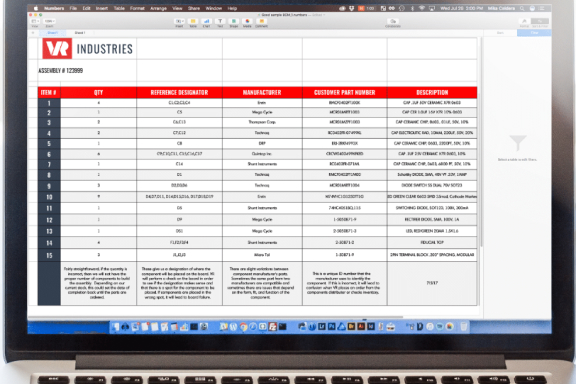
- Incomplete documentation. A kit without an inventory list, assembly drawings, or current build documentation cannot be verified against the bill of materials, so setup waits for the missing files.
Most of these problems are avoidable with a checklist and a short conversation before the kit ships. At VR Industries, your Program Manager reviews kit requirements with you during project setup, so production begins with a complete, verified material set.
Questions to Ask Before You Decide
Whichever model you lean toward, ask your contract manufacturer how it inspects consigned parts at receiving and what it does when it finds a suspect component. Ask how lot and date codes are recorded and carried into build records, and how short kits and attrition are handled. Ask what documentation it needs to set up a consigned project, and whether its quality systems match your regulatory requirements. The answers show quickly whether a partner is ready to protect your parts and your records.
How VR Industries Supports Both Models
VR Industries supports both consigned manufacturing and turnkey manufacturing from our 35,000 square foot facility in Warwick, Rhode Island. Both run on the same processes and quality systems, including ISO 9001:2015 and ISO 13485:2016 certification, ITAR registration, and FDA registration. A dedicated Program Manager serves as your single point of contact either way.
If you are weighing consigned vs turnkey PCB assembly for a regulated program, Ask an Expert to talk through your supply chain, or submit a Request for Quote with your bill of materials to see how each model would work for your project.